Basic Principles in Attack

Why basic principles?
In contrast to the “big brother” football, handball has a large range of tactical variations, which brings different defensive plays (man to man defense, space defense, offensively formations, defensively formations e.t.c,) and offensive systems (playing directions and conceptions, team and group tactics) into feature.
Therefore, “Hall chess with tempo 200” is a suitable name for what takes place on the playing court in 60 minutes. Nevertheless, despite – or because of – the tactical variety and the high speed, simple plays are often successful. The task of the coach is namely to allow his players to be capable of acting against different opposing measures. The art consists of giving procedural instructions and decision-making aids, also for requirements in complex situations, so that the player can find a fast and effective solution when under match stress. Behind this background lies the goal of this contribution; to define and describe the four basic principles for an attack play. It is assumed that these basic principles have generally accepted characteristics – that apply to the play man to man defense and space defense. The implementation of technical questions in relation to the basic principles is presented here.
“Hall chess with tempo 200” is a suitable name for what takes place on the playing court in 60 minutes.
The first basic principle: open the central clearance!
In most halls the central area is drawn – it is the surface within the 3-point throw zone of the basketball field. Attackers in this area are in principle dangerous; they are however more dangerous if they penetrate this area with high speed! Therefore, the players there should – similarly described previously with basketball for the 3 second zone – not stop for a length of time (Fig. A1 and A2).


Also, it is not always necessary to position a player as a line player. In mini handball – with predefined man to man covering – only a few children are so skillful as to act successfully from a position with their back to the goal. In the case of beginners, if the attacker who possesses the ball is under pressure from the defender, he will turn his back to his opponent (and the goal). In that way, they want – inadvertently from their point of view – to avoid the confrontation. Children, who are already able to solve such situations, are needed due to their ability to play for the game structure and should not be placed on the line. After entering without the ball, the player may not stay there for a length of time, and should depart for the side or towards the center line – as a rule – away from the ball. The instructions from the coach, during offensive man to man defense, might be “open!” or “disperse!”. This principle applies to the play against space defense as well. Additionally, the occupation of external positions and line player position are entering, in order to create more space for the backcourt player. (Fig. A3 and A4).
The instructions from the coach, during offensive man to man defense, might be “open!” or “disperse!”


Often the problem results from the fact that the attackers get too close to the defense. In particular, if they approach the defense and then do not move away from it – being unable to receive the ball – then they are too far away to apply pressure to the defense. In order to achieve optimal positioning and offer each player the possibility to act from his position with pressure, the players must learn through reverse movements to separate themselves from the defense. The instructions of the coach might be “Out from the defense!” or “away from the opponent!”
The instructions of the coach must might be “Out from the defense!” or “away from the opponent!”
The second basic principle: right of way for the ball possessor!
This statement means that – against the man to man defense – the ball possessor should really look for a way to the goal. A way to the goal does not mean: “maybe you have the possibility and maybe could run in the direction of the goal a little – but please not too far“. Or “would you like to play with more caution for the sake of it?” Right of way is an obligation: “If you have the ball, then you are to advance on the goal with as much speed as possible. Search the gap and run towards the goal!” (Fig:. B1 and B2).
“If you have the ball, then you are to advance on the goal with as much speed as possible. Search the gap and run towards the goal!”


In connection with this, the fellow players are obligated to keep the possible way clear for the ball possessor. Players with the ball, who hesitate and thereby develop no speed indirectly, request the assistance of their fellow players. This assistance then sees the available run to the player in need, responds to the signals and calls – and thus ball players develop from mini handball. It is important, in playing against a space defense, that the opponent’s goal is threatened by each position. Each player in the backcourt and wing positions has the obligation, when has the ball possession, to undertake the attempt play around the opponent. In particular in the wing positions, this is only rarely converted into the younger age categories, although the straight width areas – given with an offensive defense (“gaps”) – offer good possibilities for this (Fig. B3 and B4).
“Each player in the backcourt and wing positions has the obligation, when has the ball possession, to undertake the attempt play around the opponent.“

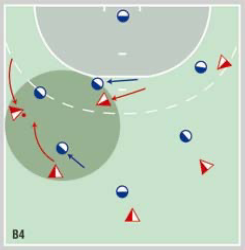
The more defensive the defense acts, the smaller areas and gaps will appear for the offense in the wing positions and the more unattractive the possibility of acting from dangerous positions on the goal becomes. In the comparison between attacking against man to man defense and against space defense, it becomes clear that the technique spectrum of the attacker changes. While the attacker frequently develops pressure by dribbling to the opposing goal against man to man defense, in the space defense the defensive players act no longer as man oriented, but according to their position on the court. Thus, they put less pressure on the attackers, who can now produce dynamics by moving forward without the ball. The development of the interaction between the wing and backcourt positions, leads to the position play.
The third basic principle: covering of the ball possessor to the rear!
Let us suppose that the ball possessor tries with high speed to reach the goal and the cover will try to block the way – if necessary with several defensive players. The breakthrough attempt depends on the proper dribbling of the ball and also the technical ability of the ball possessor. At the end of the dribbling – and possibly after stepping around the “hostile” defenders who block the way to the goal – the support of fellow players becomes necessary (Fig. C1 and C2).

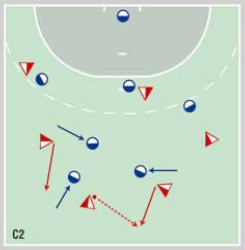
This “assistance” (and the coaching instructions should also be like this) should be in such a way that one or maximally two fellow players should offer themselves ready for the receiving of the ball. However, in order to make it more difficult for the defense to intercept the ball, the assistance must take place behind the ball possessor, because the defensive players are standing in front of him. In the attacking play against offensive space covering, assistance is also necessary, if an additional neighbouring defensive player doubles against up the ball possessor. Furthermore, the correct timing for the position play is hidden behind this principle: While the ball possessor advances to the opposing goal – his team mates must coordinate their forward movement in such a way that the ball possessor can pass the ball at any time without the defense intercepting this pass (Fig. C3 and C4).
“While the ball possessor advances to the opposing goal – his team mates must coordinate their forward movement in such a way that the ball possessor can pass the ball at any time without the defense intercepting this pass”


This time – space coordination develops only after a longer period of time.
The fourth basic principle: moving the play!
The ball must be brought as fast and securely as possible into an area (on the other side of the playing court), where on the one hand team mates are already waiting (“openly dispersing”), and on the other hand none or only a few defensive players are there (Fig. D1 and D2).


The classic means for moving the play – in football the centre changeover – would be the long space opening pass. The players – including handball beginners – do this gladly and often, but unfortunately mostly in the sidelines. More effective, surer and always fast enough, are the several short passes or a fast dribbling with a following short pass.
In the position attack against an offensive space covering, dribbling plays a minor role while the short and fast passes are the key element of the game (Figs. D3 and D4).
“In the position attack against an offensive space covering, dribbling plays a minor role while the short and fast passes are the key element of the game“.


From a tactical viewpoint, this principle lies behind the idea to place emphasis on the side of the playing court (e.g. 4 against 4) and on the other side (2 against 2 in the large area). Children should aim for this – particularly against the offensive space covering – while unconsciously learn the tactical basics.
Fewer tactics – more basics!
The described basic principles hardly concern themselves as “tactics against man to man and space defense”. There are rather the fundamental procedural instructions, how a team (in the sense of cooperation with the ball possessor and those without the ball) should act in connection. From these procedural instructions, (general) play actions (in the sense of special movements, i.e. techniques) can be derived in the next step. It is important, that the basic principles keep their meaning independently of the defensive play. This applies to the man to man defense, to the offensive space defense and right through to the attacking play against a defensive defense! It should also be noted, that the offensive game – and especially the shooting distances – depend on the position of the defense. Therefore, the question is : Regarding the offense, what should be the initial distances of the attackers from the defense, in order to be able to score? The answer to this question is linked to the individual attacking techniques and cooperative ball transport: dribbling and passing/ catching. In principle, dribbling is necessary, in order to extend the individual space of each player. The permitted three steps control hardly leave necessary space and time for demanded creativity in new generation training. Competition forms, which forbid dribbling, in fact they prevent the training creativity. So the ball possessor for instance, after a successful play around the half court against a man to man defense, must continue dribbling, as long as he is not attacked by a second defensive player. Therefore, the playing systems with reduced dribbling (e.g. two taps per ball possession) are to be re-evaluated. Why should a child “reconstruct” with difficulty, going for the goal after the duel is won…? The importance of the pass play increases in measure, in which the defense increases from man to man defense to space defense and ignores the distance to the attack. Attacking against man to man defense is more ‘a dribbling game’ – while playing against space defense is more ‘a passing game’.
“Attacking against man to man defense is more ‘a dribbling game’ – while playing against space defense is more ‘a passing game.”
Result
Therefore, the basic training of the handball specific play is based on the training of the techniques, an intensive training of the perception and the linkage with the described basic principles. Based on these three elements, beginners can learn how to play “tactic – free” for a relatively long period of time. The goal of the placing must be bringing the beginners into situations to solve issues by their own decisions. In addition, the basic principles form the frameworks. Only later should the bound play (in the sense of tactical systems and operational sequence) be introduced.
“Therefore, the basic training of the handball specific play is based on the training of the techniques, an intensive training of the perception and the linkage with the described basic principles”.
Klaus Feldmann, Coach & Lecturer bei Handball-Akademie.de


